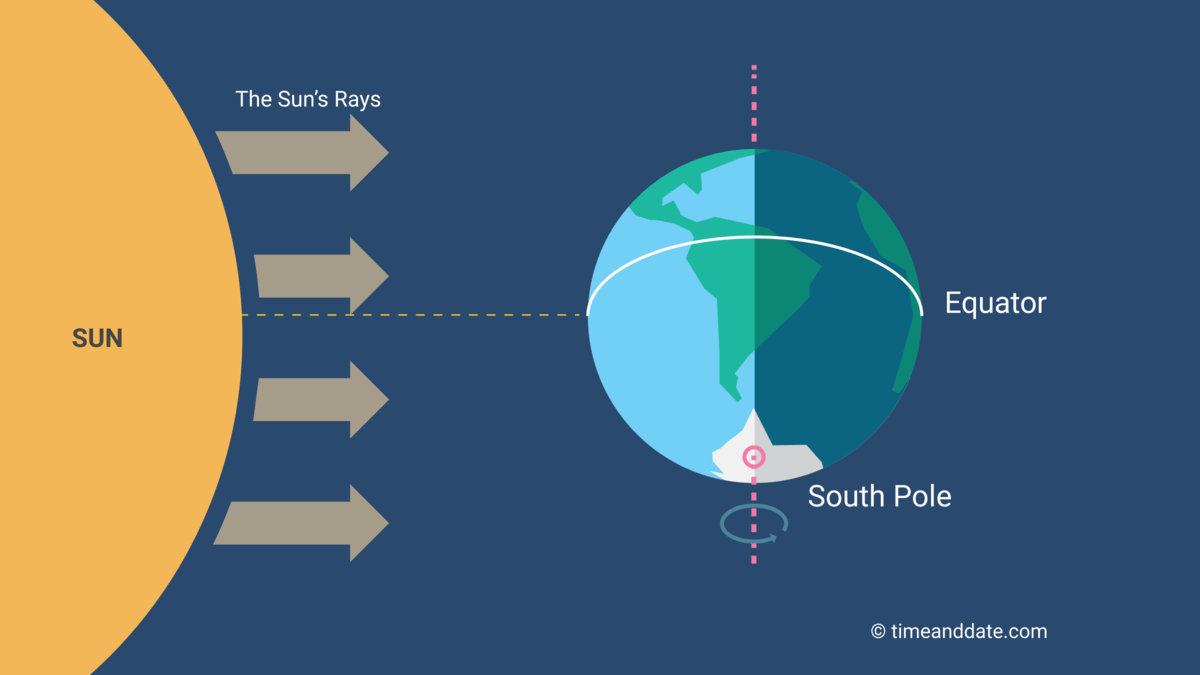

In Washington, D.C., the Autumnal, or September, Astronomical Equinox occurs Tuesday, September 22, 2026, at 8:05 p.m. EDT.
There are two equinoxes every year: one in September and one in March. The September equinox is that moment when the Sun crosses the celestial equator—an imaginary line in the sky above Earth's equator—from north to south. This happens on September 22, 23, or 24 in most years.
During the year, the subsolar point—the spot on the Earth's surface directly beneath the Sun—slowly moves along a north-south axis. Having reached its northernmost point at the June solstice, it starts moving southward until it crosses the equator on the day of the September equinox. The December solstice marks the southernmost point of its journey.
The subsolar point moves north and south during the year because the Earth's axis is tilted at an angle of about 23.4° in relation to the ecliptic, an imaginary plane created by Earth's path around the Sun. In June, the Northern Hemisphere is tilted toward the Sun, and the subsolar point is north of the equator. As the Earth travels toward the opposite side of its orbit, which it reaches in December, the Southern Hemisphere gradually receives more sunlight, and the subsolar point travels south.
On the days of the equinoxes, the Earth's axis is perpendicular to the Sun's rays, meaning that all regions on Earth receive about the same number of hours of sunlight. In other words, night and day are, in principle, the same length all over the world. This is the reason it's called an "equinox," derived from Latin, meaning "equal night."
However, this literal translation is not entirely true. The shortest day of autumn Equinox doesn't have exactly 12 hours of daylight and 12 hours of darkness. The equinox in September is the start of fall in the Northern Hemisphere and the beginning of spring south of the equator.
Astronomical autumn in 2026 begins on September 22 at 8:05 p.m. and ends with the winter solstice on December 21 at 3:50 p.m. The season lasts approximately 89 days, 20 hours, and 45 minutes. The longest day of autumn is September 22, with about 12 hours and 9 minutes of daylight. The shortest day is December 21, the winter solstice, with about 9 hours and 26 minutes of daylight.