
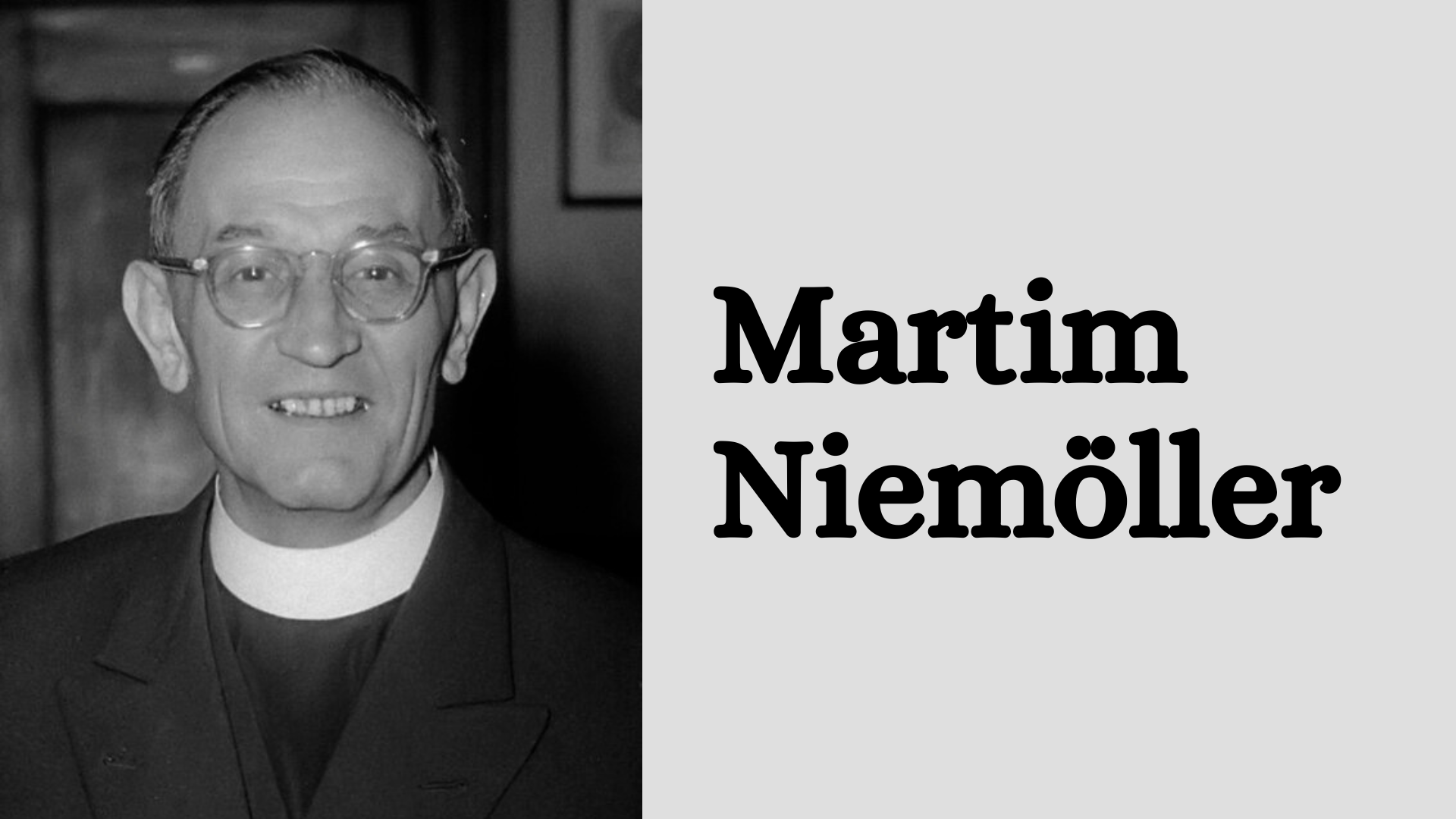
Martin Niemöller was the author of one of the most iconic quotes about the Holocaust:
First, they came for the socialists, and I did not speak out—because I was not a socialist.
Then they came for the trade unionists, and I did not speak out—because I was not a trade unionist.
Then they came for the Jews, and I did not speak out—because I was not a Jew.
Then they came for me—and there was no one left to speak for me.
—Martin Niemöller
Niemöller was a Lutheran pastor in Germany who initially supported the nationalistic, and antisemitic Nazi ideas in the 1920s and early 1930s. Because he believed that the Republic, led by those who signed the Treaty of Versailles, had crippled Germany, he supported the unsuccessful Kapp-Lüttwitz Putsch that aimed to overthrow the government in 1920. Niemöller was a member of an organization of right-wing students called the Academic Defense Corps.
When Hitler defiantly led Germany out of the League of Nations in October 1933, Niemöller (representing the Pastor’s Emergency League) sent him a telegram of congratulations, emphasizing the patriotism of PEL members. Moreover, antisemitism was widespread within the PEL and subsequently in the Confessing Church (a German Protestant Movement). Niemöller remained an outspoken antisemite throughout the 1930s, justifying his prejudices by referring to Christian teachings that the Jews were guilty of deicide, the killing of Jesus.
However, after Adolf Hitler came to power, Niemöller became a vocal critic of the regime, particularly regarding its interference in the Protestant Church. His opposition led to his imprisonment in Nazi concentration camps from 1937 to 1945.
The famous quote reflects Niemöller’s remorse for his earlier inaction and the silence of many Germans during the persecution of various groups, including, socialists, trade unionists, Jews, and others. He articulated this sentiment in speeches after World War II, emphasizing the dangers of indifference and the consequences of failing to stand up for marginalized groups. The quote serves as a powerful reminder of the moral responsibility individuals have to speak out against injustice, even when it does not directly affect them.
Niemöller’s famous quote was inspired by his personal journey from complicity to activism. The words have been adapted and used in various contexts to highlight the importance of solidarity and activism in theface of oppression, the moral imperative to speak out against injustice, and the consequences of remaining silent.
The quote has become a poignant statement about the consequences of silence and complicity, resonating in discussions about human rights and social justice especially today. It serves as a cautionary taleabout the dangers of apathy and the need for collective action against tyranny.
After the WWII, Niemöller went on tour around the world to condemn the Nazi cause and educate people about the importance of human rights.