
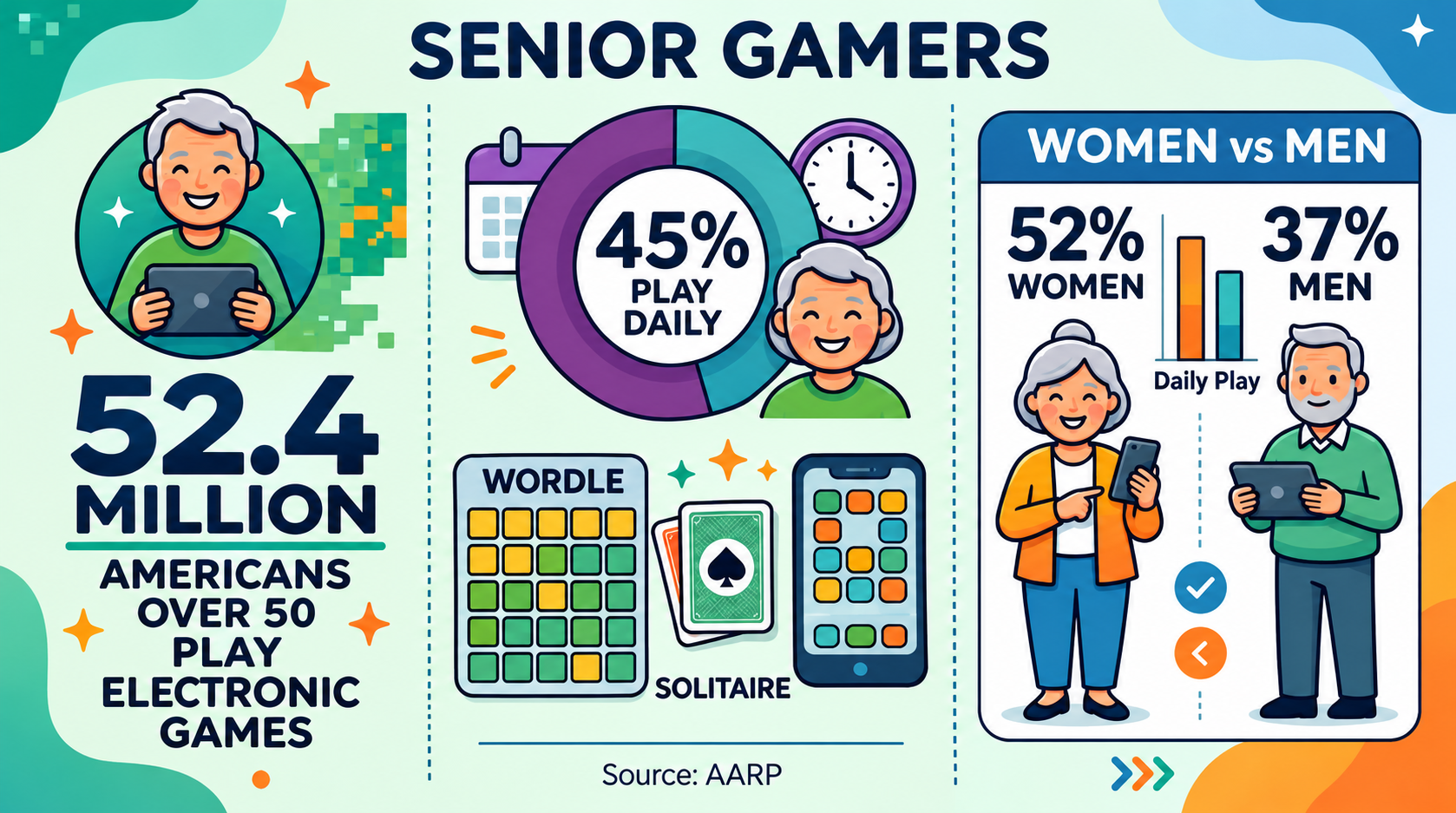
If you play Wordle or Solitaire online, on an electronic device, or smart phone, then you are part of a growing US demographic of gamers over 50 that reached 52.4 million in 2023. The numbers are increasing along with the aging population to represent 49% of the US population over 50 who play video games every day. Women lead the daily play activity at 52% to Men at 37% daily play.
Older players turn to games to relax, stay mentally engaged, relieve stress and create personal "me time" within their daily routines. One in 5 older gamers play every day, yet only 10% identify as gamers, a gap that shows how fully gaming has entered everyday life without becoming central to most players' identities. On average, older gamers spend about 12 hours per week playing games and typically invest around $49 on gaming-related purchases every six months.
Most older gamers play alone on their mobile devices, usually a smartphone, rather than using gaming consoles. A typical session lasts 15 to 60 minutes. These patterns make gaming convenient and easy to fit into daily life. Players value relaxation, mental stimulation, fun, and control over when and how long they play.
Research shows older gamers to be a diverse group differing in frequency, motivations, and preferred experiences. Analysis shows that gaming helps people cope with loss, illness, caregiving, and recovery. Among those who play with others, games can also strengthen family bonds and reinforce connections with friends; 35% play with a child or grandchild. Participants described role reversal, shared laughter, distance bridging, and new family memories.
The findings point to an opportunity for game designers and communicators to focus on the outcomes adults 50-plus seek — reward, challenge, escape, wellness and connection — rather than relying on age-based stereotypes.
Despite their growing numbers, many older gamers feel that new games are not designed with their needs in mind. About 70% believe that modern games overlook their preferences, particularly regarding difficulty settings and gameplay mechanics.
The challenge for the gaming industry will be to include this growing segment in the market, not by to creating "old people's games," but recognizing the diversity of older players and designing around the outcomes they seek: reward, challenge, escape, wellness and connection.
If you want to join this growing trend, AARP has free online games including word and trivia games, mahjong, puzzles, solitaire and arcade games. The New York Times also has free games at The Crossword — The New York Times